Independent, human-verified security attestation for AI-built software
Procurement, auditors and acquirers want proof from a party that did not build the app. ArgosX is that independent third party: we verify AI-generated apps with an AI scan plus human review and issue a signed attestation your buyer's security team can verify.
Independent runtime testing · human verification · signed evidence · custom, invoiced
A builder cannot grade its own homework
The platform that generated the code has a stake in it passing. We do not. That independence is the whole point of an attestation a reviewer will accept.
Close the deals AI-built code is stalling
Enterprise procurement increasingly blocks AI-generated software without an independent security sign-off. ArgosX gives you the third-party attestation that clears the review.
Move the risk off your team
When AI-built software ships an auth or data-access flaw, it is your brand and your client relationship on the line. An independent verification is a vendor-liability shield: it puts a party whose job is to catch these first between you and that exposure.
Proof, not self-assessment
ArgosX has no stake in the code passing. That is the entire reason an attestation is one a reviewer, an auditor, or an acquirer will actually accept.
Evidence your auditor can read
Every assessment produces a versioned, cryptographically signed artifact designed for a procurement review.
A sample of the evidence an attestation is built on: the report an assessment produces, worst-first with fixes.
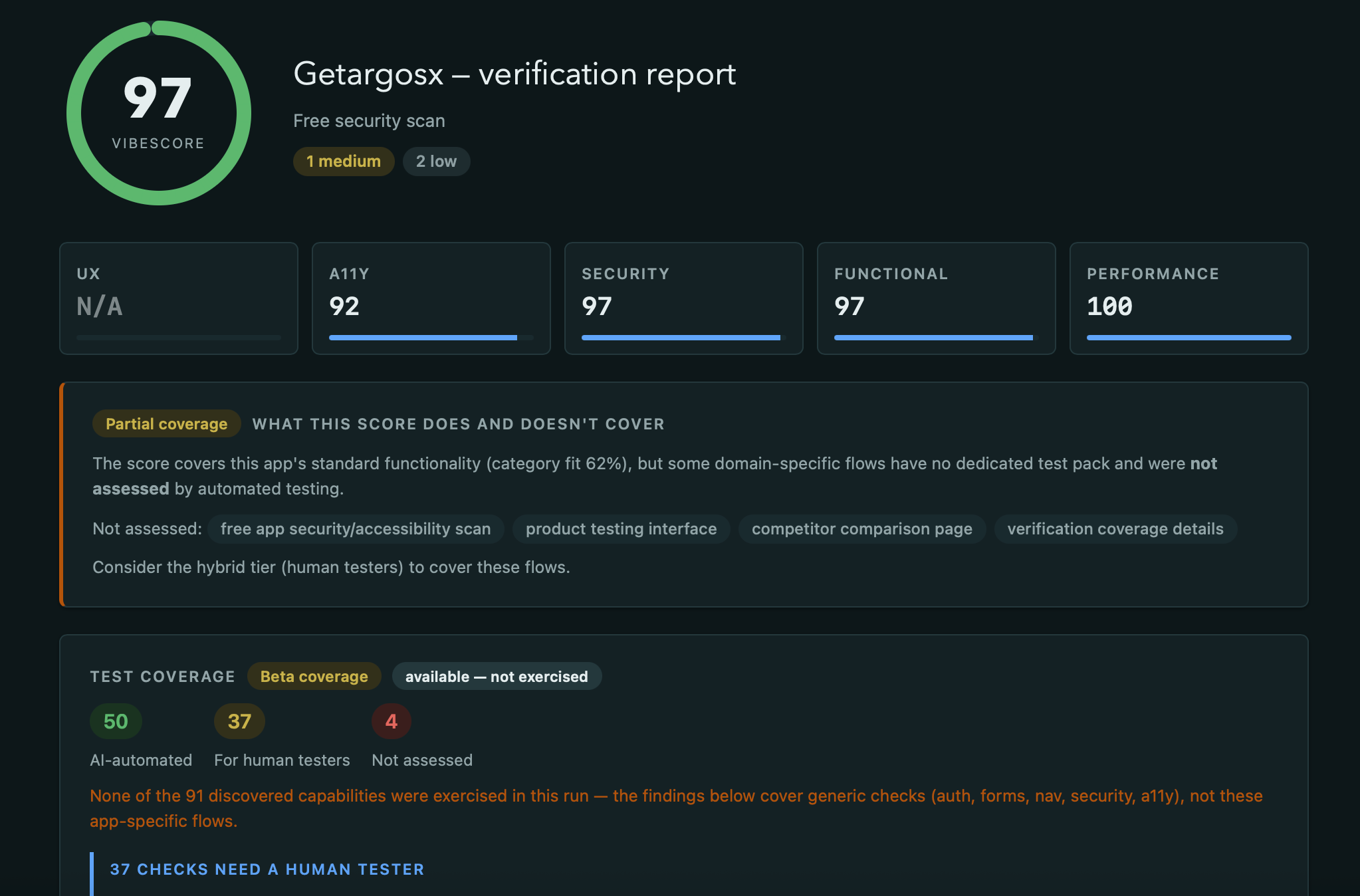
Per-finding control mapping
Findings map to the controls buyers ask about: OWASP Top 10 categories and CWE weaknesses. Checks that do not map stay visibly unmapped.
Human-verified findings
A named human verifier confirms findings before they enter the attestation, with the verifier identity and timestamp recorded in the artifact.
Tamper-evident by design
The attestation is signed, its evidence is content-hashed, and a public verifier page confirms authenticity and whether a newer version supersedes it.
What an ArgosX attestation is, and is not
Buyers reject inflated claims faster than they reject findings. Ours are scoped so they hold up.
Independent third-party evidence
An outside party tested the running app and verified what it found. The artifact states exactly what was tested and what was not.
Aligned to regulatory patterns
The assessment and re-assessment structure follows the independent-evaluation pattern regulators are converging on.
Not a certification
It is not a conformity assessment, a notified-body opinion, or an accredited penetration test, and we will never present it as one. It is the evidence layer those processes ask you for.
Re-attested on every commit
AI-built software changes fast, so a one-off scan ages out. The CI gate re-attests your app on every commit and fails your build only on security defects that are new since your last attestation, and only on the classes that matter: broken access control, data exposure, exposed secrets. An issue you have already accepted does not fail the build, so your pipeline keeps moving. Point-in-time human-verified attestations back this up for a procurement review, and any re-issue supersedes the prior artifact on the public verifier, so an outdated result cannot pass as current.
Bound to a release
Each attestation records the release it covers. Re-attest a new release and the previous artifact reads as superseded on the public verifier, so an old result cannot be presented as current.
Delta gate, not alert fatigue
The CI check fails a build only on findings that are new since the last attestation, so your team is not blocked by a backlog it already accepted, the reason most security gates get switched off. GitHub first, with SARIF output for your security tab. It also enforces a coverage floor: if a re-scan covers more than 20% fewer routes than the last one, the build fails, so a scan that quietly went blind cannot pass as clean.
Score benchmarked to the corpus
The VibeScore is an independent security score benchmarked against a corpus of AI-built apps we have scanned, so the number comes with context: how apps built the same way typically fail.
Deliver it verified, under your brand
Every app you ship can carry an independent attestation you resell to your client as a line item. It is co-branded, not white-label: the independence is the product, so the ArgosX mark stays on the attestation while your brand leads everything else.
Prove your work is secure
Hand each client a signed, independent attestation that reads Independently Verified by ArgosX. It carries the independence a client's security team accepts.
Close bigger, upmarket deals
An independent verification is the line item that unblocks the security review standing between you and larger clients.
Stop wearing your clients' security risk
When an independent party verifies the app, the exposure sits with the party whose job is to catch it, not with you.
Get an independent verdict before your buyer asks for one.
Tell us what you are shipping and we will scope a launch-readiness assessment. Custom, invoiced.